

introduction:
Artificial intelligence is becoming more advanced every day. A few years ago,
we mostly used AI to ask questions, create images, and get simple answers.
But in 2026, AI is moving much further.
Now we are hearing a lot about AI agents.
But what exactly are AI agents? Are they just another name for ChatGPT?
Can they actually help us solve real-world problems? And how do they work?
Let’s explore AI agents from the basics to more advanced concepts.
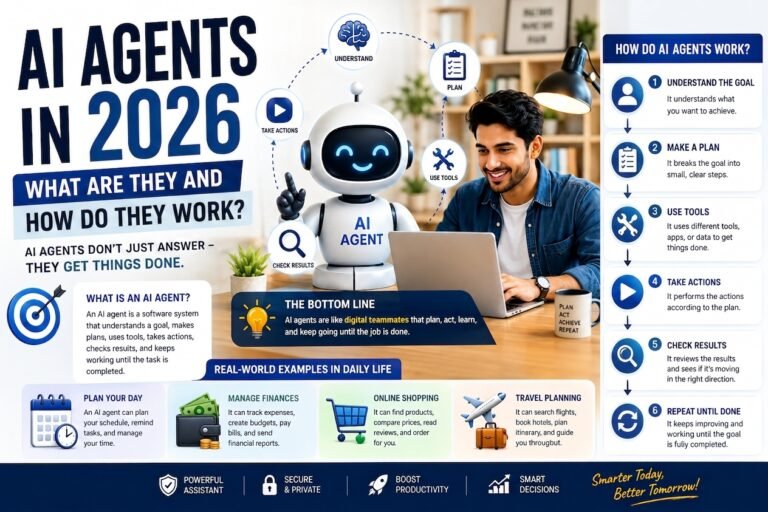
In simple words, an AI agent is a software system that can take a task
and work on it step by step. It understands what you need, makes a plan, uses
different tools, checks the results, and keeps working until the desired result
is achieved.
For example, instead of asking AI, “Help me manage my shopping,” an AI agent
could check your shopping list, find the items you need, compare available
options, and add the selected products to your cart if you give it permission.
That is the big difference.
A normal chatbot mainly talks with you. An AI agent is designed
to work for you.
In this article, we will explain AI agents in simple language, how they work,
where they are used, their benefits and risks, and what we can expect from them
in 2026.
What Is an AI Agent?
An AI agent is basically an AI-powered software system that is designed to
complete a specific task or work toward a particular goal.
It can use a language model, such as an LLM (Large Language Model), to
understand user instructions and decide which steps are needed.
An AI agent can:
- Understand a user’s goal
- Break a large task into smaller steps
- Make decisions
- Use external tools when needed
- Search for information
- Access databases or applications
- Remember useful information
- Check the results of its actions
- Change its plan when something goes wrong
- Complete multiple steps with less human involvement
So, the easiest way to understand an AI agent is:
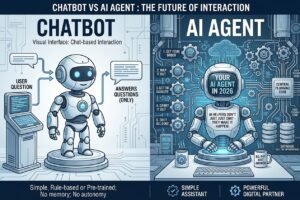
Chatbot → Gives you an answer to your question.
AI Agent → Helps you complete a task.
However, we cannot say that AI agents are completely independent.
The level of freedom an agent has depends on how it is designed and what
permissions the user gives it.
AI Agent vs. Chatbot: What Is the Difference?
Many people ask about the difference between an AI agent and a chatbot.
The main difference is how they handle a task.
A chatbot usually works like this:
You → Ask a question → AI → Gives you an answer
For example, if you ask a chatbot to write a 500-word article about electric
cars, it will write the article and usually stop there.
An AI agent can work like this:
You → Give a goal → AI plans → Uses tools → Takes actions → Checks results
→ Continues → Completes the task
For example, you could give an AI agent this instruction:
“Research the latest electric car trends and prepare a report.”
The agent may then:
- Search for information.
- Collect information from different sources.
- Compare the information.
- Organize the important points.
- Identify useful statistics.
- Write the report.
- Review its work.
- Make corrections.
That is why AI agents are more action-oriented than traditional chatbots.
However, the abilities of an AI agent depend on the tools connected to it.
How Do AI Agents Work?
The technology behind AI agents may look complicated, but the basic idea is
quite simple.
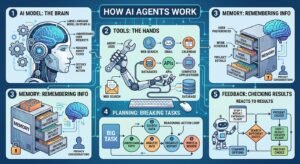
Most AI agents have several important parts working together.
1. AI Model: The Brain
The first important part is the AI model.
This can be a large language model or another AI model that can understand
instructions and reason about tasks.
The model helps the agent understand:
- What the user wants
- What information is available
- What needs to be done
- Which action should happen next
You can think of the AI model as the brain of the agent.
But the model alone is not enough.
An AI model that can only generate text cannot automatically book a ticket,
update a spreadsheet, or send an email.
That is where tools come in.
2. Tools: The Hands of the Agent
AI agents can be connected to external tools. These tools allow an agent to
perform tasks outside the AI model itself.
For example, an agent might have access to:
- Web search
- Calendar
- Databases
- Computer applications
- APIs
- Coding environments
- Business software
- File storage
Imagine an AI agent that helps a business owner.
“Check today’s sales and tell me which products are performing best.”
The agent could access the company’s sales database, analyze the information,
and prepare a summary.
Without access to the database, the agent could only provide general advice.
So, tools allow an AI agent to move from thinking to doing.
3. Memory: Remembering Information
Memory is another important part of modern AI agents.
An agent may need to remember information during a task. Some systems can also
store useful information for future interactions.
For example, a personal AI agent might remember:
- Your preferred writing style
- Your regular schedule
- Your work preferences
- Projects you are working on
- Previous instructions
This means you may not have to explain everything again each time.
Memory can make an AI agent more useful because it can work with context instead
of starting from zero.
However, memory also raises privacy questions. Users should understand what
information an agent stores and who can access it.
4. Planning: Breaking a Big Task Into Small Steps
One of the important abilities of an AI agent is planning.
Suppose you tell an agent:
“Create a report about the AI industry.”
This is a large task. Instead of trying to do everything at once, an agent may
break it into smaller steps:
- Understand the topic.
- Search for reliable information.
- Collect important data.
- Compare different sources.
- Organize the information.
- Write the report.
- Review the report.
- Improve mistakes.
This process is sometimes called an agent loop or
reasoning-action loop.
The basic idea is that the agent decides what to do, takes an action, checks
the result, and then decides what should happen next.
5. Feedback: Checking What Happened
An agent should not simply take an action and assume everything worked.
It can check the result and decide what to do next.
For example:
Goal: Find the best flight.
Step 1: Search flights.
Result: Only expensive flights are available.
Step 2: Search different dates.
Result: A cheaper flight is found.
Step 3: Compare the options.
Step 4: Present the best choice to the user.
This ability to react to results is one of the things that makes AI agents
different from simple automation.
A Simple Example of How an AI Agent Works
Let’s make it even easier to understand.
Imagine you tell an AI agent:
“Find three good laptops under $800 for programming.”
The agent may work like this:
Step 1: Understand the Goal
It understands that you want three laptops, your budget is $800, and the
laptops should be suitable for programming.
Step 2: Make a Plan
It decides to search for laptops, compare specifications and prices, and then
select suitable options.
Step 3: Use Tools
It searches websites or product databases.
Step 4: Collect Information
It looks at RAM, processor, storage, display, price, and other important
specifications.
Step 5: Compare
It compares the available options.
Step 6: Check the Results
It removes laptops that do not meet your requirements.
Step 7: Give You the Result
Finally, it presents the best options and explains why they were selected.
That is the basic idea behind an AI agent.
Will AI Agents Replace Humans?
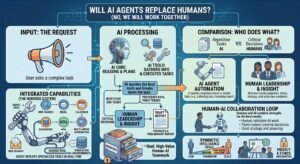
This is a question many people are asking. AI agents may take over some
repetitive tasks, but that does not mean humans will become unnecessary.
Many jobs may simply change. People will still be needed to make important
decisions, solve new problems, be creative, and check the work done by AI.
For example, an AI agent might collect information and prepare a report, while
a person reviews it and decides what to do next.
Working together may be more useful than expecting AI to handle everything
alone.
What Does the Future Hold for AI Agents?
AI agents are still improving, and their abilities are likely to grow.
They may handle bigger tasks, work with more apps and tools, and work together
with other AI agents.
We may also see them move beyond computers and interact with robots, machines,
and other physical devices.
But smarter AI also brings more responsibility. Agents need to be secure,
reliable, and properly controlled, especially when they are allowed to make
decisions or take actions on their own.
Final Thoughts
AI agents are becoming an important part of AI in 2026. Unlike a simple
chatbot, an agent can be designed to understand a goal, plan the steps, use
tools, and take action.
They can save time and help people with many everyday and professional tasks,
but they can also make mistakes. That is why human checking and the right
permissions are still important.
The future is likely to be less about AI replacing everyone
and more about people and AI working together to get things
done.
Frequently Asked Questions About AI Agents
What is an AI agent in simple words?
An AI agent is a software system that can understand a goal, plan steps, use
tools, and take actions to complete a task with limited human help.
What is the difference between AI and an AI agent?
Traditional AI can provide predictions, recommendations, or generated content.
An AI agent is designed to use AI capabilities to pursue a goal and take
actions, often across multiple steps.
Is ChatGPT an AI agent?
ChatGPT is primarily an AI assistant, but some features can perform agent-like
tasks by using tools and completing multi-step work. The exact capabilities
depend on the feature or mode being used.
Can AI agents work without humans?
Some AI agents can perform tasks with limited human involvement. However,
humans may still be needed for supervision, approvals, important decisions,
and unexpected situations.
Are AI agents safe?
AI agents can be useful when properly designed, tested, monitored, and given
appropriate permissions. However, more autonomous agents can also introduce
security, privacy, and reliability risks.
Will AI agents replace jobs?
AI agents are likely to automate some tasks and change many jobs. They may also
create new roles and increase the value of skills involving AI, technology,
decision-making, creativity, and communication.
Why are AI agents important in 2026?
AI agents are important because AI is moving from simply generating information
toward taking actions and completing multi-step tasks. This could change how
people use software and how businesses operate.
****** Short Intro of this Article ******
AI agents are becoming one of the most exciting parts of AI in 2026.But what are they, and how are they different from the AI tools we already use?In this article, we explain AI agents in simple words with easy real-life examples.
You’ll learn how they work, what they can do, and what benefits and risks they bring.
By the end, you’ll have a clear idea of why AI agents could change the way we use technology.




Pingback: How to Make Money with AI in 2026: 15 Real Ways to Build Online Income?