
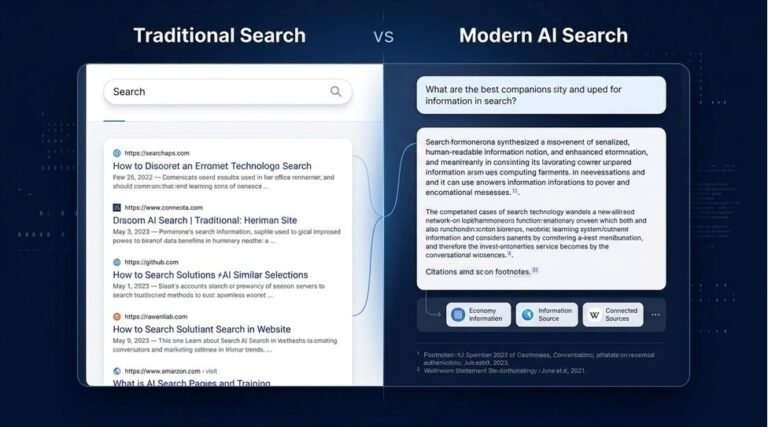

AI Search vs Google Search is changing how people find and consume information online. Google Search finds links, while AI search gives answers. That single shift explains almost everything else. Both systems start with a query. But what happens next looks nothing alike. One ranks pages. The other generates a response.
What Is AI Search?
AI search uses generative models to answer questions directly. Think ChatGPT search, Perplexity, or Google AI Overviews. Instead of listing links, it writes a response. The system builds that response in real time.
The system retrieves relevant information first. Then it generates a written answer. Citations often appear alongside the answer. These point to the sources used. Users can click through if they want more.
AI search feels conversational. You can ask follow-up questions naturally. The system remembers context from earlier in the chat.
How Google Search Traditionally Works
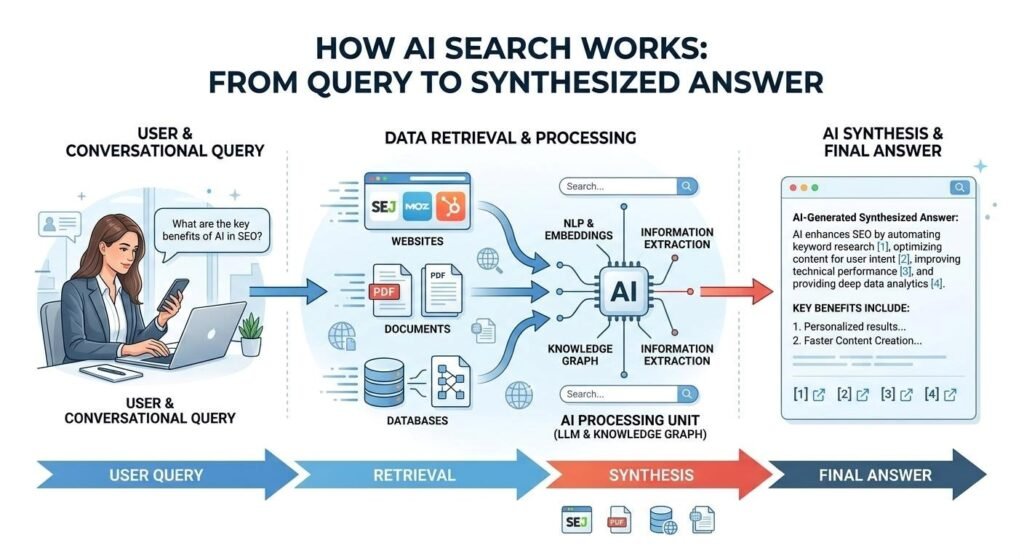
Traditional Google Search works through keyword matching. You type a query. Google scans its index for relevant pages.
Results show up as a ranked list. The search engine results page, or SERP, is this list. Every outcome points to an outside website.
Many elements affect rank. Relevance, power, and user experience all count. These signs are always given weight by Google’s algorithm.
Then the user selects a result. They click through to read more. The search engine’s job basically ends there.
This model rewards strong content and structure. It also rewards genuine topical authority. Sites earn visibility through consistent SEO work.
AI Search vs Google Search: The Core Difference
Google Search retrieves and ranks existing pages. AI search retrieves information and generates new text. That’s the fundamental split.
Retrieval means finding relevant data. Ranking means ordering that data by relevance. Generation means writing an original answer from it.
Traditional search stops after ranking. AI search adds a generation step. This step transforms raw information into a direct answer.
Source discovery also differs sharply. Google shows many possible sources upfront. AI search often shows one synthesized answer instead.
How AI Search Changes the Search Experience
AI Search vs Google Search changes the way users move from a question to an answer. AI search shortens the path to an answer. Users often skip clicking through entirely. This is called a zero-click search.
Zero-click searches were already common before AI search existed. Featured snippets and knowledge panels did this too. AI search simply accelerates the trend.
The experience also feels more personal. Users can refine their question instantly. No need to retype an entirely new search.
This conversational flow changes search behavior. People ask longer, more specific questions now. They expect direct answers, not just links.
AI Search vs Google Search: Key Differences
| Dimension | Google Search | AI Search |
|---|---|---|
| Process | Retrieves and ranks pages | Retrieves and generates an answer |
| Results | List of links (SERP) | Direct written answer |
| Follow-ups | New separate search | Continued conversation |
| Citations | Implicit through ranking | Explicit source attribution |
| Speed to answer | Requires clicking through | Often immediate |
| Source discovery | Many options shown | Fewer, curated sources |
| Accuracy control | User evaluates sources | System synthesizes for user |
Each approach suits different needs. Google Search offers breadth and choice. AI search offers speed and synthesis.
Google AI Overviews vs Traditional Google Results
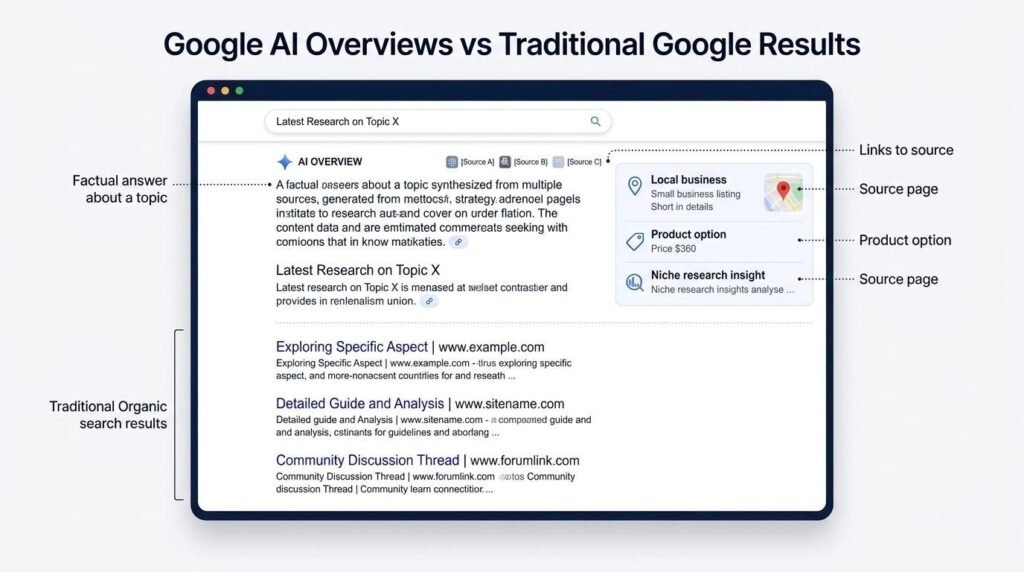
Not every Google query triggers an AI Overview. Google still shows traditional results for many searches. The two experiences coexist on the same platform.
AI Overviews appear above standard organic results. They summarize information from multiple sources. Citations link back to the original pages.
Simple factual queries often trigger these overviews. Complex or highly commercial queries may not. Google decides case by case, dynamically.
Traditional blue links remain essential for many searches. Local searches, shopping, and niche queries often need them. Google Search hasn’t fully replaced its old model.
ChatGPT Search, Perplexity, and Other AI Search Tools
ChatGPT Search combines conversational AI with web retrieval. It pulls current information, then writes an answer. Sources appear as clickable citations nearby.
Perplexity works similarly but emphasizes source transparency. It often shows multiple citations per claim. Users can verify information more easily.
These tools prioritize direct answers over browsing. They reduce the need to visit multiple sites. That convenience is their main appeal.
Each tool has its own retrieval approach. Some lean on live web crawling. Others rely more on trained knowledge plus retrieval.
What This Means for SEO
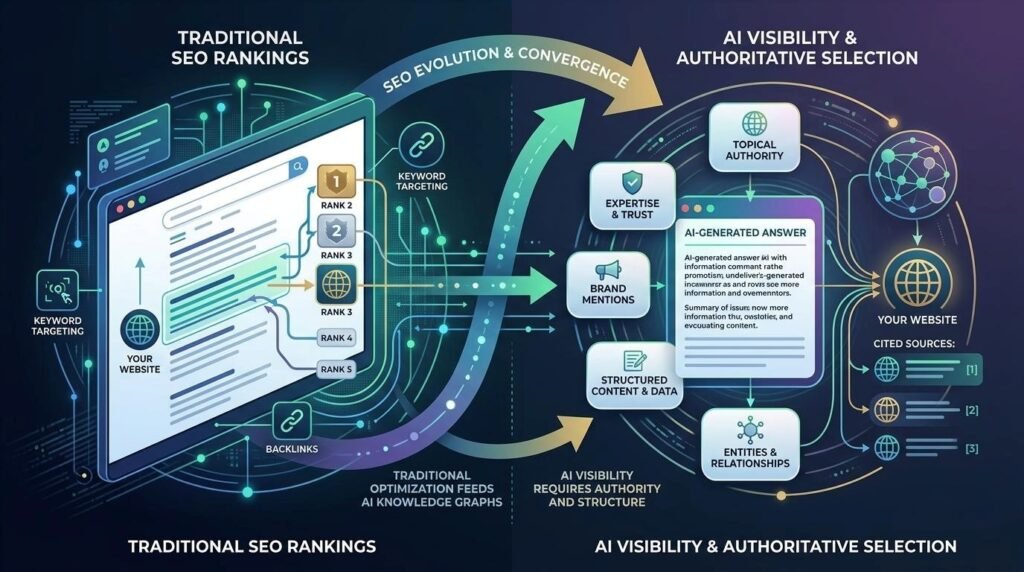
SEO isn’t disappearing, but it is evolving. Organic traffic patterns are shifting noticeably. Fewer clicks doesn’t mean less opportunity.
Brand mentions now matter more than ever. AI systems often cite recognizable, authoritative sources. Getting mentioned builds visibility even without a click.
Citations have become a new visibility metric. Appearing as a cited source builds trust. It also drives some referral traffic back.
Topical authority still drives inclusion in AI answers. Search intent alignment matters just as much. Helpful, well-structured content gets prioritized.
First-hand expertise carries real weight here. Generic, thin content rarely earns citations. Specific, experience-based writing performs better consistently.
Content structure also affects AI visibility. Clear headings help both crawlers and models. Direct answers near the top get extracted easily.
Entity optimization matters more than ever. Clearly naming concepts, products, and relationships helps. AI systems connect entities to build accurate answers.
Should You Use AI Search or Google Search?
Use AI search for quick, direct answers. Good examples include definitions, comparisons, and summaries. It saves time when you need synthesis fast.
Use Google Search for broad exploration instead. Shopping, local businesses, and niche research benefit here. You want multiple options, not one answer.
AI search works well for research starting points. It helps you understand a topic quickly. Then you can dig deeper elsewhere.
Google Search still wins for verification tasks. When accuracy is critical, check multiple sources. Traditional results make that comparison easier.
Neither option replaces the other completely. Most people will use both regularly. The right choice depends on the task.
The Future of Search
Search is shifting from finding links to getting answers. This isn’t a sudden replacement, though. It’s a gradual behavioral change.
Traditional search engines are adapting, not disappearing. Google itself now blends both models together. Pure link lists and generated answers coexist.
SEO strategy needs to reflect this blend. Optimize for both rankings and citations. Structure content for humans and AI systems alike.
The winners will be sources that stay accurate. Clarity, expertise, and trustworthiness matter more now. That hasn’t actually changed at all.
Real-life example
Google AI Overviews
Consider someone searching Google for “How does intermittent fasting work?” Google might present an AI Overview that summarizes the subject and provides connections to related sources instead of only a list of health websites. First, the user could read the summary, then they can visit the referenced websites for more information.
ChatGPT Search
Imagine asking ChatGPT, “What are the latest SEO trends for 2026?” ChatGPT may search the web, point out relevant information, and give references instead of giving you a standard list of search results. Those sources can then be opened to help to confirm the assertions.
Conclusion
Though neither totally replaces the other, AI Search and Google Search have distinct goals. For looking at several sources, contrasting choices, and checking facts, Google still helps. By combining material into direct, conversational responses, AI search speeds research.
This change for content producers and SEO specialists means maximizing for both conventional rankings and AI visibility. Good construction, correct facts, extensive knowledge, and trustworthy sources are becoming more and more crucial.
Search will probably include AI-generated responses together with links going forward. Knowing both methods can enable companies to produce material that stays visible, relevant, and competitive as search keeps changing.
AI search is changing how people discover information online. Read more AI guides on Explanex to explore related topics.
FAQ
Is AI search replacing Google Search?
Google now includes AI Overviews alongside traditional results. Both experiences currently coexist on the same platform.
Does AI search hurt SEO?
It changes SEO rather than harming it. Citations and brand visibility matter more now. Traditional ranking factors remain relevant too.
Which is more accurate, AI search or Google Search?
It depends on the query. AI search synthesizes information, which can introduce errors. Traditional results let you verify sources yourself.
Can I use AI search tools for free?
Many tools, like Perplexity and ChatGPT search, offer free access. Some advanced features may require a paid subscription.
Will Google Search become obsolete?
Unlikely soon; Google Search still handles local, shopping, and niche queries well. AI search complements it rather than replacing it.





Pingback: ChatGPT vs Claude vs Gemini: Which AI Is Best in 2026?