
This is Raza from Explanex Last month I left ChatGPT open for almost three hours straight, drafting an entire content calendar,
rewriting titles, asking it to “just try one more version” about twenty times. Then a random YouTube short
popped up claiming every AI chat “drinks a bottle of water.” I actually stopped typing and just stared at the
screen for a second. Was I really out here wasting water for fun taglines?
That question sent me down a two-week rabbit hole. So here’s what I actually found about AI water usage no scare tactics, no vague “AI is destroying the planet” panic, just the real 2026 numbers, where they
come from, and what you can genuinely do about it.
Wait, Why Does AI Even Need Water?
This part confused me at first too. AI doesn’t “drink” water like a person. The water goes into cooling the
servers that keep your prompt from literally melting the hardware.
There are two totally different things being counted here, and almost every viral post mixes them up:
- Direct (on-site) water — the water evaporated inside a data center’s own cooling towers
- Indirect (grid) water — the water used at power plants to generate the electricity the data center pulls
from the grid
A company can report a tiny direct number while its total footprint, once you include the power plant, is way
bigger. That’s not lying, it’s just picking which pipe you’re measuring.
How Much Water Does AI Use in a Single ChatGPT Query?
This is the number everyone wants, and honestly, it depends who’s answering.
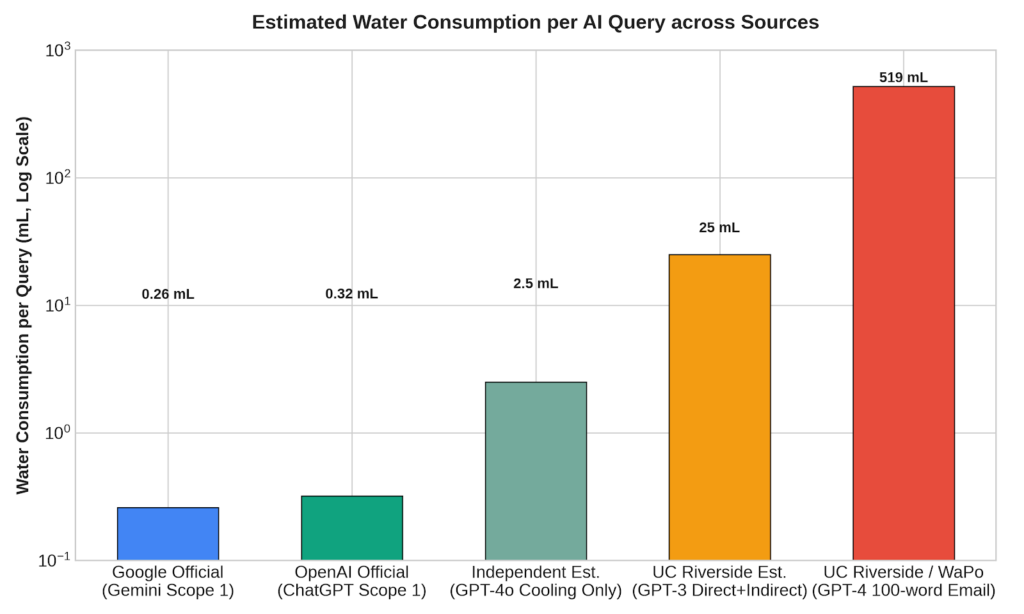
- OpenAI’s Sam Altman said an average query uses roughly 0.32 mL of water — that’s on-site cooling only
- Google reports its median Gemini prompt at about 0.26 mL, using the same narrow scope
- UC Riverside researchers, counting the electricity’s water footprint too, put it at 10–25 mL per query
- A more recent, grid-adjusted estimate from independent analysts lands closer to 1–5 mL for a typical
query on modern hardware
- A more recent, grid-adjusted estimate from independent analysts lands closer to 1–5 mL for a typical
Here’s the same numbers side by side, so you can see why the “one bottle per query” claim never held up:
| Source | Estimated Water Per Query | What’s Included |
|---|---|---|
| OpenAI (Sam Altman) | ~0.32 mL | On-site cooling only |
| Google (Gemini) | ~0.26 mL | On-site cooling only |
| UC Riverside | 10–25 mL | On-site + power plant water |
| Independent grid-adjusted estimate | 1–5 mL | On-site + power plant, newer hardware |
| Viral “bottle” claim | ~500 mL | Outdated, since revised down by original researcher |
Basically, one prompt costs you somewhere between a few drops and a tablespoon. Not a bottle. That “519
mL per email” figure everyone shares? Even the researcher who made that estimate has since revised it way
down, and it was never meant to apply to today’s more efficient systems.
The Bigger Picture: AI Water Consumption in 2026
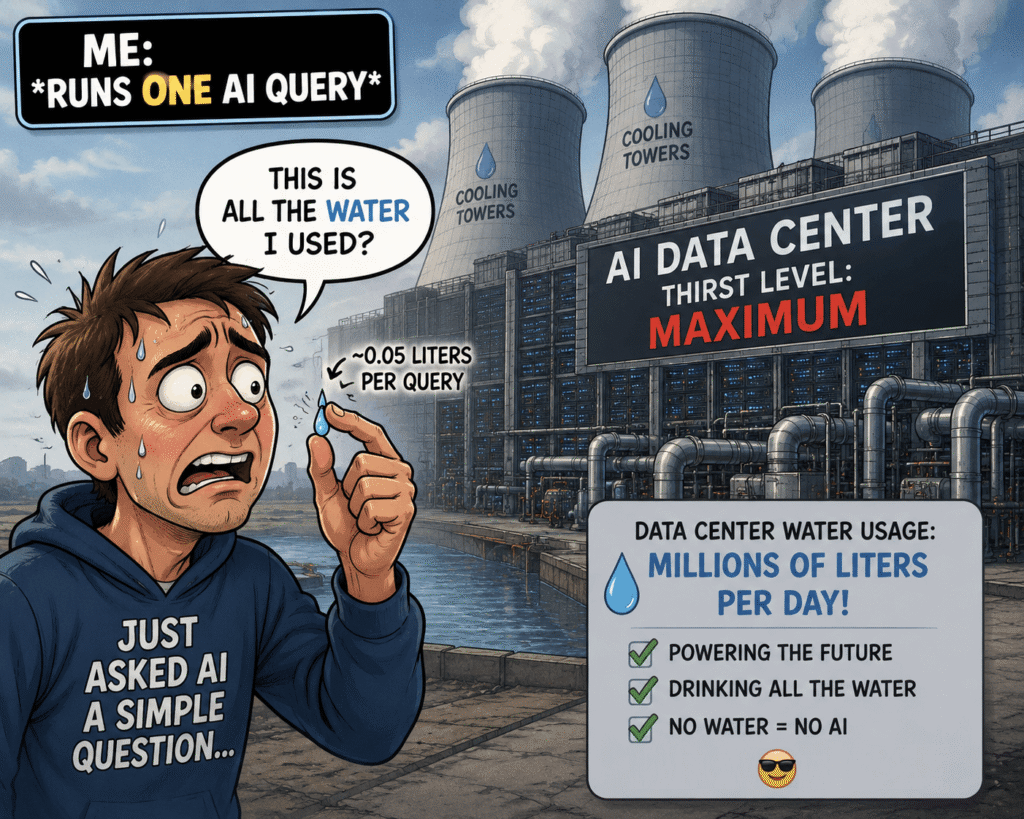
One query is tiny. Billions of queries a day is a different story.
Here’s where it gets real:
- Google’s data centers consumed 10.9 billion gallons of water in 2025, up 34% from the year before
- U.S. data centers used about 17.4 billion gallons directly in 2023, and that’s projected to hit 38–73
billion gallons by 202 - Including the electricity side, U.S. data centers pulled in roughly 800 billion liters indirectly in a single
year - Global AI systems alone are estimated to have used somewhere between 312 and 765 billion liters in
2025
So no, your one late-night chat isn’t the villain. The scale of the entire industry is where the actual pressure
shows up, especially on local water systems during peak summer demand.
Take Colossus, the massive AI supercomputer campus running in Memphis. It reportedly draws close to a
million gallons a day from the same aquifer that supplies the city’s drinking water. That’s the kind of
number that actually deserves attention, not the milliliter figure from your personal chat history.
Why This Actually Bugs Me (And Probably You Too
Here’s the frustrating part. You didn’t ask for any of this scale. You just wanted a faster email draft or a
quicker way to debug your code. And now there’s a headline making you feel guilty about it.
I felt the exact same thing when I first read that “bottle of water” claim. I almost stopped using AI tools for a
week out of pure guilt, before I even checked if the number was real. It wasn’t, not in the way it was framed.
But the frustration of not knowing what to trust? That part’s completely fair.
You shouldn’t have to become a data center engineer just to use a chatbot without anxiety. Half the internet
is throwing around numbers nobody bothered to fact-check, and the other half is defending AI companies
without reading the actual research either. Neither side is really helping you make a decision.
So let’s fix that.
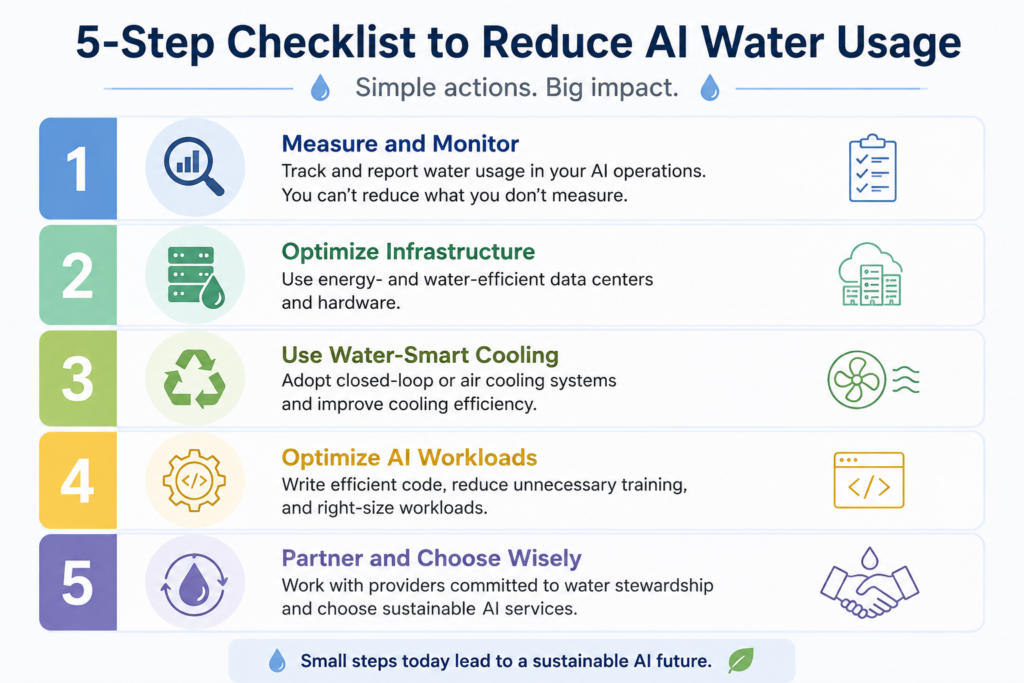
5 Practical Ways to Cut Your AI Water Footprint
You can’t control what Google or Microsoft builds. You can control how you use these tools. Here’s what
actually moves the needle:
1. Use smaller, faster models for simple tasks. A quick grammar check doesn’t need your heaviest reasoning model. Result: efficient models use under 2 mL per query versus 20–100+ mL for heavy
reasoning models on long tasks — that’s a massive drop for zero effort on your end.
2. Batch your prompts instead of chatting in circles. Combine three small questions into one clear
prompt instead of firing off five separate ones. Result: fewer total inference calls, less cooling load, and
honestly, better answers too.
3. Skip the “just one more regeneration” habit. Write a slightly more detailed prompt upfront instead
of regenerating five times hoping for magic. Result: you cut repeat processing dramatically, and you save
your own time as a bonus.
4. Turn off image generation when you don’t need visuals. A single AI image can use over 28 mL of
water, way more than a text prompt. Result: reserving image generation for when you truly need it keeps
your footprint mostly in the “a few drops” category.
5. Check which provider publishes real efficiency data. Companies like Google now publish water
usage effectiveness (WUE) numbers and replenishment goals. Result: choosing tools from providers who
are transparent nudges the whole industry toward accountability, and you’re not guessing anymore.
What’s Coming by 2030 (Brace Yourself a Little)
A June 2026 UN report projected AI-linked data centers could hit a 9.3 trillion liter annual water footprint
by 2030. That’s roughly the domestic water needs of over a billion people.
At the same time, US water utilities may need $10–58 billion in new infrastructure just to handle peak
demand from data centers, according to research out of UC Riverside and Caltech.
Here’s the part that actually matters for you:
- Efficiency per query keeps improving every single year
- But total usage keeps growing faster than efficiency gains, because AI keeps getting cheaper and more
people keep using it - That gap is exactly why the industry-level number climbs even while your personal number shrinks
Main Takeaways
- A single AI query costs you somewhere between a few drops and a tablespoon of water, not a bottle —
the scary viral number was misquoted - The real pressure comes from industry scale, not individual chats, so your guilt should go toward smarter
habits, not quitting AI tools - Picking efficient models, skipping unnecessary regenerations, and choosing transparent providers can
genuinely cut your footprint without changing how you work
Look, none of this means AI water usage is a non-issue. It’s real, it’s growing, and by 2030 it’s going to
strain local water systems in ways that deserve actual policy attention. But your individual chat window isn’t
the crisis headline made it out to be. Small habit changes on your end add up, and staying informed instead
of scared is honestly the better move here.
So tell me — did the “bottle of water per query” number surprise you too, or had you already heard the real
figure? And which of these five habits are you actually going to try this week?