

Introduction
What Is Artificial Intelligence? This is a comprehensive artificial intelligence for beginners guide, as technology changes our world. Today, understanding what is artificial intelligence has become essential because AI is already a part of our everyday lives, even if we do not always notice it. From voice assistants and chatbots to Google searches and movie recommendations, AI helps machines do things that usually need human thinking. In this guide, we’ll look at what AI is, how it works, its main types and uses, and some simple examples.
1. What is AI, and why is it so important today?
Artificial intelligence, or AI, is no longer something we only see in science fiction. We use it every day in search engines, smartphones, chatbots, online shopping, and many other services. In this guide, Explanex will explain what is artificial intelligence in simple terms, including how it works, its main types and uses, and some easy real-life examples to help you understand why AI has become so important.
2. What Is Artificial Intelligence (AI)? A Simple Guide for Beginners

When exploring what is artificial intelligence, we find that it is a technology that allows computers and machines to perform tasks that normally require human intelligence. These tasks can include understanding language, recognizing images, solving problems, learning from information, and making decisions. In simple terms, AI helps machines process information and respond in ways that can feel similar to human thinking. For a deeper technical overview, you can check the official Wikipedia page on Artificial Intelligence.
A simple example is a smartphone’s voice assistant. When you ask it a question, it can understand what you said, process the request, and provide an answer or perform an action. Another everyday example is Netflix or YouTube recommending videos based on what you have watched before. The system looks at patterns in your activity and uses them to predict what you may want to watch next.
The main difference between AI and traditional computer programs is how they handle information. A normal program generally follows specific instructions written by a developer. If the instructions don’t cover a particular situation, the program may not know what to do. AI systems, on the other hand, can be trained using large amounts of data to recognize patterns and produce useful results. This ability to learn from data is one of the main reasons why knowing what is artificial intelligence is so crucial for modern technology.
3. How Does Artificial Intelligence Work?

If you want to know how it operates alongside understanding what is artificial intelligence, it works by using data, algorithms, and computing power to identify patterns and produce useful results. Instead of simply following a fixed set of instructions, many AI systems are trained with large amounts of data. During training, the system analyzes examples and learns patterns that help it recognize information or make predictions. For example, an AI system trained with thousands of pictures of cats and dogs can learn the visual patterns that help it tell the difference between them.
Once an AI model has been trained, it can use what it has learned when it receives new information. This process is called inference. For instance, when you ask an AI chatbot a question, the system processes your words, identifies patterns in the language, and generates a response based on its training and the instructions it has been given. More advanced AI systems can also work with images, audio, video, and other types of information.
The basic process can be understood in three simple steps: data is collected, the AI model learns from that data, and the trained model produces an output when it receives new information. The quality of the data and the way the model is trained can have a major effect on the results. This is why AI may sometimes make mistakes even when it appears to understand a task. The technology is powerful, but it still depends heavily on the data, training, and design behind it.
4. What Are the Types of Artificial Intelligence?
Artificial Intelligence can be divided into different types based on how it works and what it is capable of doing. The most common classification includes Narrow AI, General AI, and Super AI. These categories help us understand the difference between the AI systems we use today and the more advanced forms of intelligence that researchers are still exploring.
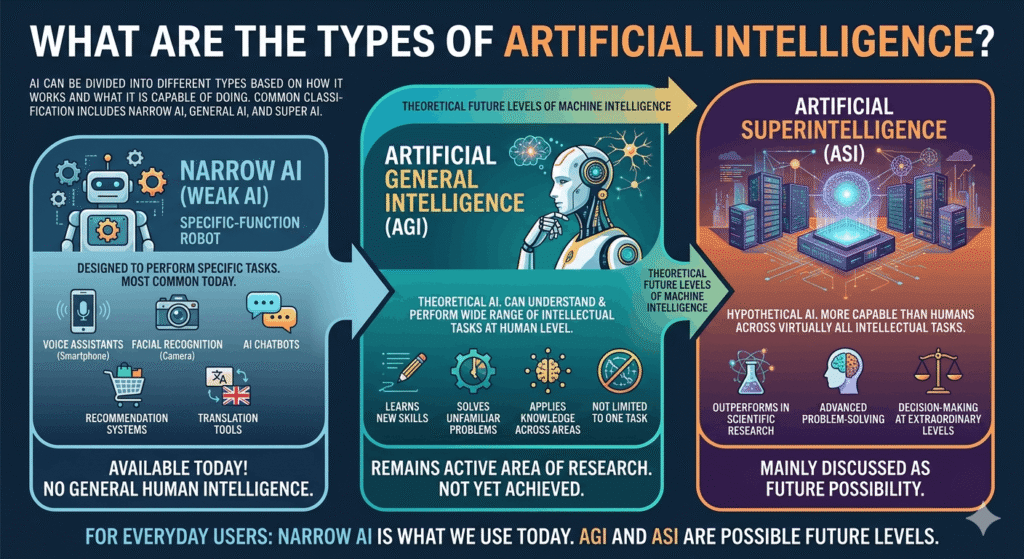
- Narrow AI: Narrow AI, also known as Weak AI, is designed to perform specific tasks. Most AI tools available today fall into this category. Examples include voice assistants, recommendation systems, facial recognition, translation tools, and AI chatbots. These systems can perform their particular tasks very well, but they don’t have general human-like intelligence.
- Artificial General Intelligence: Artificial General Intelligence, or AGI, refers to a theoretical form of AI that could understand and perform a wide range of intellectual tasks at a level comparable to humans. Unlike Narrow AI, an AGI system would not be limited to one specific task. It could potentially learn new skills, solve unfamiliar problems, and apply knowledge across different areas. AGI has not been achieved in a generally accepted sense and remains an active area of research.
- Artificial Superintelligence: Artificial Superintelligence, or ASI, describes a hypothetical AI system that would be more capable than humans across virtually all intellectual tasks. It could potentially outperform humans in areas such as scientific research, problem-solving, and decision-making. ASI does not currently exist and is mainly discussed as a future possibility in AI research and technology discussions.
For everyday users, the most important thing to remember when studying what is artificial intelligence is that Narrow AI is the type of AI we commonly use today. AGI and ASI describe possible future levels of machine intelligence rather than technologies that are currently available in the same way.
5. What Technologies Power AI?
Artificial Intelligence is not powered by a single technology. It is built from several technologies that work together to help computers process information, recognize patterns, learn from data, and produce useful results. Some of the most important technologies behind modern AI include machine learning, deep learning, neural networks, natural language processing, computer vision, and powerful computing hardware.
- Machine Learning: Machine learning allows computers to learn patterns from data and improve their results without needing a separate instruction for every situation. It is used in applications such as recommendations, fraud detection, search engines, and predictive systems.
- Deep Learning: Deep learning is a more advanced form of machine learning that uses large neural networks with many layers. It is especially useful for handling complex information such as images, speech, video, and large amounts of text. Many modern AI applications rely on deep learning to achieve accurate results.
- Neural Networks: Neural networks are computing models inspired loosely by the way biological brains process information. They contain connected layers of mathematical units that transform input data and help the system identify patterns. Neural networks are widely used in image recognition, language processing, and other AI applications.
- Natural Language Processing: Natural Language Processing, or NLP, helps computers understand and work with human language. It is used in chatbots, translation tools, voice assistants, search systems, and applications that analyze or generate text.
- Computer Vision: Computer vision allows AI systems to analyze and understand information from images and videos. It can be used for facial recognition, medical image analysis, object detection, security systems, and many other tasks.
Pros and Cons of Artificial Intelligence at a Glance
| Advantages (Pros) | Disadvantages (Cons) |
|---|---|
| 24/7 Availability: Works continuously without needing breaks or sleep. | Job Displacement: Can automate tasks and replace manual human labor. |
| Zero Human Error: Performs complex mathematical calculations with 100% accuracy. | No Human Emotion: Lacks empathy, moral judgment, and emotional understanding. |
| Handles Repetitive Work: Efficiently manages boring, mundane daily tasks automatically. | High Implementation Costs: Requires expensive hardware and frequent software updates. |
| Fast Decision Making: Processes massive amounts of data in seconds to give results. | Dependency on Data: Can produce biased or wrong results if the training data is poor. |